
Preparing for the FRCR 2B examination requires more than strong radiology knowledge. Candidates must demonstrate accurate image interpretation, clinical reasoning, effective communication and safe patient management.
Following the FRCR 2B examination changes introduced in June 2025, candidates need a more structured and component-specific preparation strategy.
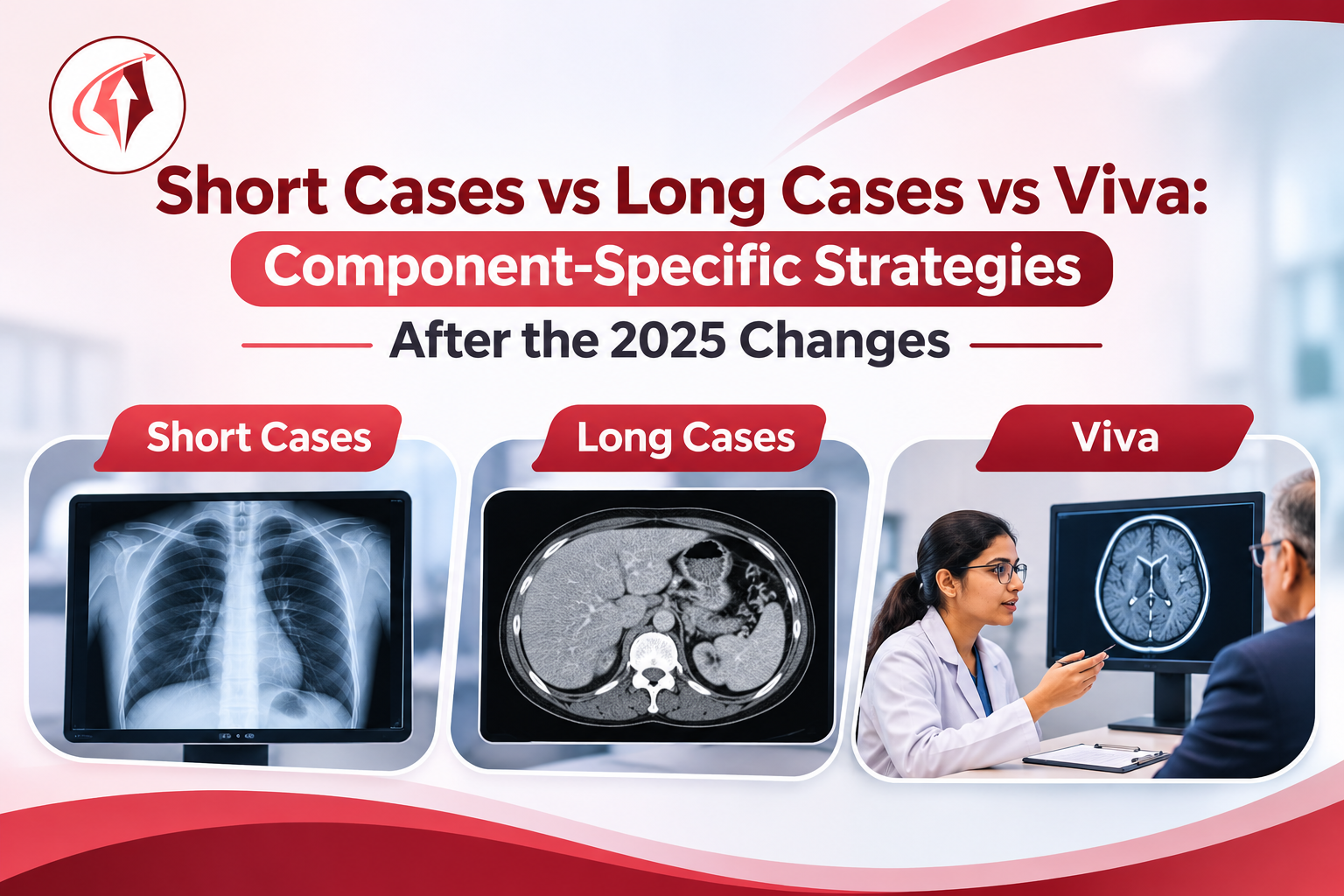
The updated examination continues to assess three essential areas: short case reporting, long case reporting and oral examinations (viva). However, the introduction of short case reporting and revised assessment methods has changed how candidates should approach their preparation.
Understanding the FRCR 2B Exam Format After the 2025 Changes
The Royal College of Radiologists (RCR) introduced changes to the Final FRCR Part B examination from June 2025.
One of the most significant changes was replacing the traditional rapid reporting examination with a short case reporting component.
The examination now includes:
| Component | Exam Format | Duration |
|---|---|---|
| Short Case Reporting | 25 abnormal plain radiograph cases requiring brief reports | 120 minutes |
| Long Case Reporting | 6 complex imaging cases requiring structured reports | 75 minutes |
| Oral Examination (Viva) | 12 cases across two oral stations | 2 × 30 minutes |
The underlying radiology knowledge expected of candidates remains unchanged. However, the examination places particular importance on clinical interpretation, appropriate recommendations and clear communication.
Understanding what each component assesses is the first step towards developing an effective FRCR 2B study plan.
1. FRCR 2B Short Cases: Focus on Accuracy, Efficiency and Clinical Safety
Short case reporting is a key component of the revised FRCR 2B examination.
Candidates are presented with 25 abnormal plain radiographs, accompanied by clinical information. They must identify relevant imaging findings, provide a diagnosis and recommend appropriate further management.
Unlike the previous rapid reporting format, candidates are expected to produce short written reports rather than simply classify images as normal or abnormal.
What Should You Focus on During Short Case Preparation?
Develop a systematic image interpretation approach
Every radiograph should be reviewed systematically, regardless of how obvious the abnormality appears.
For chest radiographs, assess the lungs, pleura, mediastinum, heart, bones and visible devices.
For musculoskeletal radiographs, evaluate alignment, cortical integrity, joint spaces, soft tissues and relevant adjacent anatomy.
A consistent search pattern reduces the likelihood of overlooking significant findings.
Practise concise reporting
The new short case format rewards clear communication.
An effective response should include:
- Relevant positive imaging findings.
- The most likely diagnosis.
- Important complications, where applicable.
- Appropriate next steps or management recommendations.
For example, when identifying a pneumothorax, it is not enough to name the abnormality. Candidates should recognise associated signs of tension when present and recommend urgent clinical escalation if indicated.
Improve time management
Candidates have 120 minutes to complete 25 cases, equivalent to approximately 4.8 minutes per case.
A practical approach is to avoid spending too long on one difficult radiograph.
Complete the report, make a clinically reasonable recommendation and move forward.
Common Short Case Mistakes
Candidates should avoid vague descriptions, excessive differentials, missing additional abnormalities and failing to recommend appropriate management.
The goal is to demonstrate safe and effective radiological reporting.
2. FRCR 2B Long Cases: Build Strong Clinical Reasoning Skills
The long case reporting component assesses a candidate’s ability to interpret complex imaging and produce a structured radiology report.
Candidates must complete six cases within 75 minutes.
Each case may include multiple imaging modalities, such as CT, MRI, ultrasound or nuclear medicine.
A Practical Strategy for FRCR 2B Long Cases
Start with the clinical history
Clinical information often provides valuable clues.
Consider the patient’s age, presenting symptoms, relevant medical history and suspected pathology before reviewing the imaging.
This helps narrow the differential diagnosis.
Use a structured reporting approach
Organise the response into the required sections:
- Observations
- Interpretation
- Principal diagnosis
- Differential diagnosis
- Further management
Descriptions should include major abnormalities, their distribution and any relevant complications.
Avoid lengthy reports that repeat the same findings.
Prioritise the most likely diagnosis
A common examination mistake is providing an extensive differential diagnosis without identifying the most likely condition.
Candidates should use the imaging findings and clinical context to justify their preferred diagnosis.
Recommend clinically appropriate management
Safe recommendations may include further imaging, specialist referral, multidisciplinary team discussion or urgent clinical escalation.
These should be proportionate to the findings.
Time Management for Long Cases
With 75 minutes for six cases, candidates have approximately 12.5 minutes per case.
Practise reviewing images, identifying key findings and writing structured reports within this timeframe.
Attempting every case is important. Spending excessive time on one case can compromise performance across the examination.
3. FRCR 2B Viva: Demonstrate Confidence and Clinical Judgement
The oral examination assesses more than diagnostic knowledge.
Candidates are expected to interpret images, explain their reasoning, discuss differential diagnoses and demonstrate safe clinical decision-making.
The updated assessment evaluates five domains:
- Knowledge
- Observation
- Clinical reasoning
- Clinical safety and management
- Communication
How to Approach an FRCR 2B Viva Case
Begin with the most important imaging findings.
For example:
“The CT demonstrates a focal lesion in the right hepatic lobe with peripheral nodular enhancement and progressive centripetal filling, most consistent with a hepatic haemangioma.”
This response communicates the imaging observation and its interpretation clearly.
Next, be prepared to explain why the findings support the diagnosis.
If necessary, discuss relevant differentials and how further imaging might distinguish them.
Finally, explain whether the patient requires additional investigation, follow-up or specialist management. A structured approach to an FRCR 2B viva case can help keep this sequence clear.
Develop Effective Viva Communication Skills
Clear communication is essential.
Candidates should:
- Speak audibly and confidently.
- Use accurate radiological terminology.
- Avoid unnecessary speculation.
- Explain findings logically.
- Acknowledge uncertainty when appropriate.
- Prioritise urgent clinical concerns.
Being decisive does not mean pretending to know every answer.
A safe, structured approach is more valuable than an unsupported diagnosis delivered confidently.
4. How to Divide Your FRCR 2B Preparation Time
A balanced study schedule should include all three components.
An illustrative weekly preparation plan could include:
| Day | Preparation Activity |
|---|---|
| Monday | Short case reporting practice |
| Tuesday | Long case interpretation and reporting |
| Wednesday | Viva practice with a study partner |
| Thursday | Paediatric and musculoskeletal cases |
| Friday | Chest radiology and emergency imaging |
| Saturday | Timed mock examination |
| Sunday | Review mistakes and revise weak topics |
Adjust the schedule according to your performance and available study time.
The objective is not simply to complete more cases but to improve interpretation accuracy, reporting quality and examination confidence.
5. Why Mock Exams Are Important for FRCR 2B Success
Timed mock examinations help candidates identify weaknesses that may not be obvious during routine revision.
Mock sessions provide opportunities to practise:
- Image interpretation under examination conditions.
- Concise written reporting.
- Structured clinical reasoning.
- Time management.
- Oral communication.
- Safe management recommendations.
Feedback from experienced radiologists can be particularly valuable when identifying recurring reporting errors or weaknesses in viva technique.
Frequently Asked Questions About FRCR 2B Preparation
What changed in the FRCR 2B exam in 2025?
The traditional rapid reporting examination was replaced by short case reporting. Changes were also introduced to examination delivery, scoring and standard setting.
How many short cases are included in the FRCR 2B exam?
The short case reporting component includes 25 abnormal plain radiograph cases to be completed within 120 minutes.
How many long cases are included in FRCR 2B?
Candidates must report six complex imaging cases within 75 minutes.
Is communication important in the FRCR 2B viva?
Yes. Communication is explicitly assessed alongside knowledge, observation, clinical reasoning, and clinical safety and management.
What is a suitable way to prepare for FRCR 2B?
A combination of structured case practice, timed reporting sessions, mock vivas, systematic revision and tailored feedback is recommended.
Conclusion
Successfully preparing for the FRCR 2B examination requires a different strategy for each component.
The key to FRCR 2B success is not simply knowing the diagnosis. It is demonstrating that you can interpret, communicate and manage radiological findings safely.
Live sessions, mocks, and case discussions.
Join our Telegram community for regular updates, discussions, and exam-focused resources: