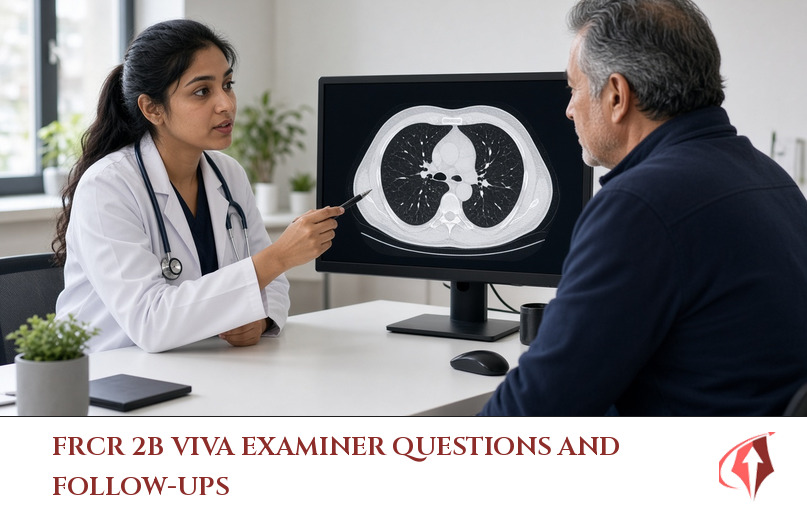
In the FRCR 2B oral examination, the first description of a case is only part of the exchange. After a working diagnosis, the examiners will usually continue with follow-up questions. Those questions test understanding, safety and judgement, not an attempt to catch you out.
This matters more if you only practise naming diagnoses.

How Follow-Up Questions Work in the Current Oral Exam
The oral component lasts for a maximum of 60 minutes, with two 30-minute stations and six cases in each station. The format is described in the RCR guidance notes for candidates. Examiners ask standard supplementary questions to assess a candidate’s understanding of the problem.
The guidance from examiners is more specific. Questions are not designed to trick a candidate or to make them doubt their original diagnosis. All candidates are asked two or three standardised follow-on questions for each case, and some of these may be more generic knowledge questions.
If you have already answered those points in your opening discussion, the examiner will move on. A structured opening can cover diagnosis, urgency and next steps before you are prompted.
You should also expect the examiner to interrupt at times so that all six cases are completed.
What Follow-Up Questions Are Usually Trying to Assess
Each oral case is marked for radiology knowledge, observation, clinical reasoning, and clinical safety and management. Communication is rated across the station. The RCR scoring system explains how those domains are recorded and weighted.
Follow-up questions often map onto those domains:
- Observation: is there another finding, a complication, or a review area you have not mentioned?
- Knowledge: do you understand the condition, its typical context, or a relevant classification?
- Clinical reasoning: why is this the most likely diagnosis, and how would you distinguish it from close alternatives?
- Clinical safety and management: what happens next, who needs to know, and is the situation urgent?
- Communication: can you answer the actual question clearly, without repeating the whole case?
A Practical Way to Approach Any Follow-Up
The same sequence still helps: observation, interpretation, diagnosis, then management. If the examiner has moved to a specific question, start with that question. How to approach any case in the FRCR 2B viva remains a sound starting structure.
Listen to the wording.
- “What else do you notice?” is an observation question.
- “What is your principal diagnosis?” asks you to commit, in order of probability.
- “Why not the alternative?” is a reasoning question.
- “What would you do next?” is a management question.
- “What is your main concern?” often points to a complication or a time-critical risk.
If anything the examiner said is unclear, ask for it to be repeated. The guidance notes encourage this.
Illustrative Practice Questions by Theme
The questions below can be used in mock vivas. They are examples for practice only, not questions taken from a live examination.
Practice questions about observations
A mock examiner might say:
- “You have described the main finding. What else do you notice?”
- “Is there a second abnormality on this study?”
- “Which side is involved?”
- “Would you like to review any particular window or series?”
- “Does the clinical history change what you are looking for?”
A focused answer names the additional finding, or states that you cannot see a further abnormality after review.
Practice questions about diagnosis and reasoning
Typical practice prompts include:
- “What is your principal diagnosis?”
- “If you had to place these differentials in order of probability, how would you rank them?”
- “Which imaging feature supports that diagnosis over the main alternative?”
- “How would the differential change if this patient were a child rather than an adult?”
A clear response links the observation to the conclusion, rather than naming the diagnosis alone. The same idea is discussed in our post on communication skills in the FRCR 2B viva.
Practice questions about further imaging
The guidance notes say that candidates should clearly state their reasons for wanting further views or investigations. The examiners’ guidance adds that you should describe, interpret and offer a diagnosis or differential before asking for further imaging.
Practice follow-ups in this area include:
- “Would you recommend any further imaging, and why?”
- “If this radiograph is inconclusive, what would you do next?”
- “What question should the next study answer?”
A safe answer explains how the extra test would change management.
Practice questions about safety and management
Clinical safety and management is a scored domain, so these questions are worth rehearsing. Illustrative examples include:
- “What would you do next?”
- “Does this finding need to be communicated urgently, and to whom?”
- “What would you expect the clinical team to do with this report?”
- “Is any further investigation required before treatment, or is the priority urgent referral?”
- “If this were a time-critical finding, such as an acute aortic dissection, significant intracranial mass effect, or suspected testicular torsion, what is the immediate action?”
Avoid a vague recommendation such as “clinical correlation advised” when the images show a finding that needs prompt action. Name the urgency and the team. Our post on emergency radiology diagnoses that must not be missed discusses several of these presentations.
Practice questions that test more generic knowledge
The College notes that some standardised follow-on questions may be more generic, to assess knowledge rather than the observations already made. In a mock, that might sound like:
- “What are the common causes of this appearance?”
- “Which staging or classification system is commonly used here?”
- “What complications would you look for?”
- “In NHS practice, what is the usual next step in the diagnostic pathway?”
How to Handle a Question You Did Not Expect
Not every case will be immediately familiar. If you are unsure, start with what you can support from the images, offer a short differential in order of probability, and give a safe next step.
If later images or a follow-up question make your first diagnosis unlikely, change it and say why. The examiners’ guidance states that candidates should not hesitate to change an initial diagnosis if appropriate, and that marks are not given for correct answers about a wrong diagnosis.
A certain amount of prompting is expected, and marks are not lost unless the prompting becomes excessive. Use a prompt as a cue to be more specific, not as a signal to abandon the case.
Practising Examiner Questions in a Mock Viva
Knowing likely question types is not a substitute for answering them aloud. In mock practice:
- Use unfamiliar cases, and ask a colleague or teacher to add two or three follow-up questions after your opening, including one management question.
- Practise moving on when the opening has already covered those points.
- Review the session against the five official domains, as described in our post on how to evaluate your own performance in an FRCR 2B mock viva.
- Include modalities that examiners have identified as weaker areas, including plain radiographs, ultrasound, nuclear medicine and paediatric imaging.
Follow-up practice tests whether your oral structure still holds once the examiner begins to ask questions. The short case, long case and viva components each require a different emphasis.
FRCR Vivacity provides online viva sessions, mock viva practice and case discussions, and records sessions for later review. Those sessions are a practical place to rehearse FRCR 2B viva examiner questions under timed conditions.
Frequently Asked Questions
Are the questions in this article taken from the real FRCR 2B viva?
No. They are illustrative practice questions for mock vivas and study discussions. They are not official College questions and should not be presented as recalled exam content.
How many follow-up questions are asked in each oral case?
The examiners’ guidance states that examiners will ask all candidates two or three standardised follow-on questions for each case. If the candidate has already answered them, the examiner moves on.
Will I lose marks if the examiner prompts me?
A certain amount of prompting is expected in every oral session. According to the examiners’ guidance, candidates will not lose marks for this unless excessive prompting is needed.
What should I do if I do not understand the question?
Ask the examiner to repeat or clarify it. The guidance notes for candidates say that you should listen carefully and ask for clarification if anything is unclear.
Conclusion
FRCR 2B viva examiner questions and follow-ups are a planned part of the oral examination. They test whether you can observe carefully, reason clearly, recommend a safe next step, and explain that thinking clearly.
Practise with illustrative questions, listen to what is being asked, and review your answers against the official domains.
Live sessions, mocks, and case discussions: https://frcrvivacity.com/
YouTube: https://www.youtube.com/@frcrvivacity2b
Join our Telegram community for regular updates, discussions, and exam-focused resources:
Telegram: https://t.me/frcr2bvivacity