
An FRCR 2B candidate recently asked me a question that stayed with me:
“If you had to sit FRCR 2B again with less than 7 days left, what would you do differently?”
Here’s my honest answer.
Let’s assume these 7 days are fully yours. After sleep, meals and basic essentials, that leaves around 12 focused hours a day. The real question is how you spend them.
My answer isn’t to study everything. It isn’t to open 20 new resources or try to learn all of radiology in a week. With 7 days to go, FRCR 2B preparation should be about exam simulation, answer structure, clinical reasoning, pattern recognition and finding your weak spots before the examiner does.
Why Should You Stick to One Set of Resources in the Final Week?
With only 7 days left, jumping between resources costs you more than it gives you. Pick one ecosystem you trust and squeeze everything out of it.
For me, that’s the material I’ve built over years of teaching FRCR candidates: FRCR Vivacity, FRCR Shorts, the FRCR Vivacity website, my courses and Crack FRCR 2B Long Cases. I trust it because I know exactly what’s been recorded, demonstrated and explained there.
That doesn’t mean other teachers or resources are wrong. Many of them are excellent. But the last week isn’t the time to start comparing.
1. How Should You Use FRCR Vivacity Videos? (2-3 Hours a Day)
Start with the FRCR Vivacity YouTube channel. There are 60+ videos on YouTube and the website, built around the 5-minute viva format.
FRCR 2B tests far more than spotting an abnormality. In each case you need to:
- Describe the findings accurately
- Interpret them
- Apply radiological knowledge
- Show clinical reasoning
- Handle follow-up questions
- Reach a diagnosis
- Suggest management
Aim for 3-4 videos a day, and watch them actively:
Pause → think → form your answer → compare → spot the gap.
Passive watching won’t help now. Treat every video as a timed viva.
2. FRCR SHORTS — HIGH-YIELD TOPICS
Next, move to the focused videos on FRCR Shorts. These are the topics where a structured answer earns easy marks.
Lines and tubes. Know how to check position, tip location and complications. If one of these comes up, you want full marks.
Lytic and sclerotic lesions. “Lytic lesion in the femur” isn’t an answer. Work through:
Location → cortical or medullary → zone of transition → periosteal reaction → matrix → cortical breach → pathological fracture → soft-tissue component.
Fractures. Don’t stop at the name. Describe:
Location → configuration → displacement → angulation → articular involvement → associated fracture or dislocation → complications → management.
Dislocations. Think:
Direction → associated fracture → soft-tissue or neurovascular injury → reduction → post-reduction imaging → management.
If time allows, do a quick pass on mediastinal masses and compartments too.
Keep asking yourself one question: “Will this improve my performance in the next 7 days?” If not, move on.
3. LONG CASES — 6 EVERY DAY
I’d aim for about 6 long cases a day. Over 7 days, that’s 42 cases.
You don’t need to write a full answer for every case. Write one complete answer a day. For the rest, analyse deeply and build the answer in your head:
Observations → key negatives → interpretation → diagnosis → management.
The goal is to train your brain to produce a short, structured, specific answer quickly. Don’t read passively. Practise answering.
4. START GIVING VIVAS
Split viva practice into three sessions: morning, afternoon and evening, with 3-4 cases each.
Keep it exam-like:
5 minutes → answer → feedback → next case.
Radiopaedia works well as a case bank if you’re practising with a friend or colleague.
What matters isn’t how many cases you scroll through. It’s how many you can reason through properly under exam conditions.
5. KEEP ONE WEAK-AREAS NOTEBOOK
Every mistake goes into one small notebook. For example:
- Missed a relevant negative
- Couldn’t identify a line position
- Forgot management
- Mixed up fracture patterns
- Missed an important complication
- Couldn’t separate the differentials
- Took too long to reach the answer
This becomes your personal FRCR syllabus. Read it every evening. Your mistakes are far more valuable to revise than things you already know well.
A Realistic 7-Day FRCR 2B Timetable
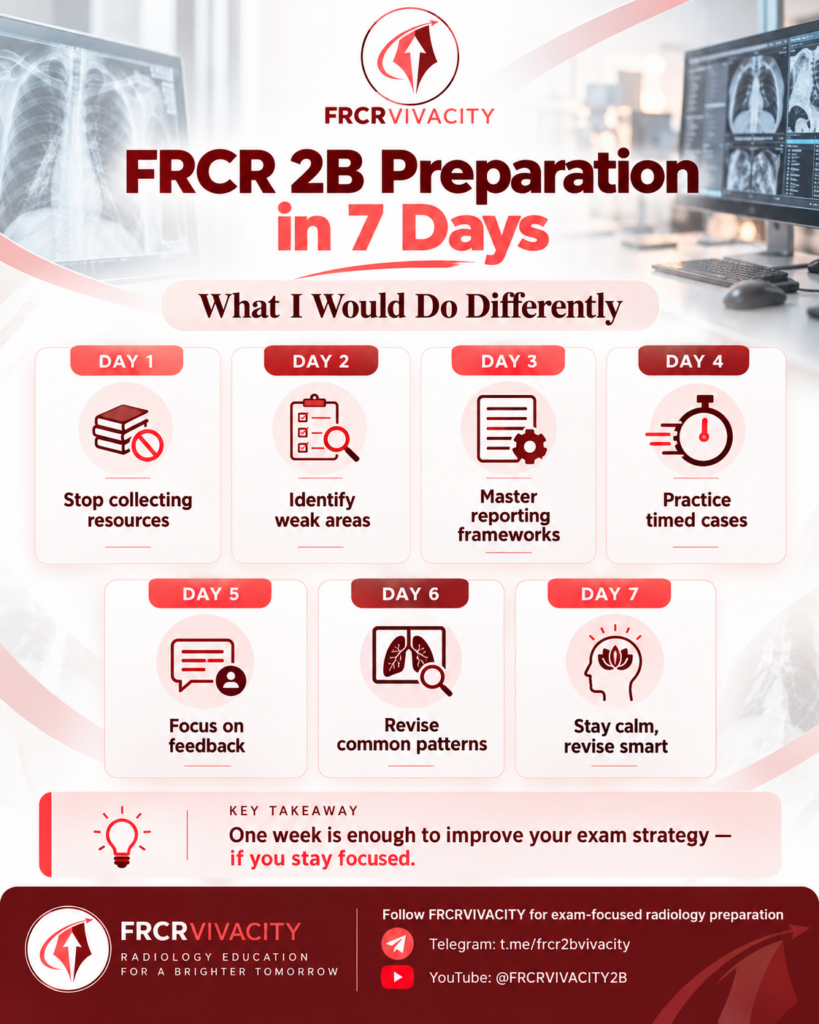
Day 1: Set up. 2 hours of FRCR Vivacity, FRCR Shorts on lines and tubes, lytic and sclerotic lesions and mediastinal masses, 6 long cases, 8-9 viva cases. Start your weak-areas notebook.
Day 2: Find your biggest weaknesses. Same routine, but pay attention to where you consistently lose marks.
Day 3: Tighten your image description. Make your systematic approach automatic.
Day 4: Fix fracture answers. Stop dropping marks on incomplete trauma descriptions.
Day 5: Make the chain automatic. Diagnosis → associated injury → management, every time, without thinking.
Day 6: Speed and structure. Check what’s still going wrong, work on timing, and run a full mock to catch exam-day problems early. Turn weaknesses into strengths. Don’t start anything new.
Day 7: Taper, don’t panic.
- Short FRCR Vivacity revision
- Quick Shorts review
- Go over your long case answer structure
- Read your weak-areas notebook
- A few viva cases only
- Rehearse your exam-day strategy
- Stop at a sensible time and sleep properly
You want to walk in fresh, confident and sharp, not exhausted.
What Does a 12-Hour Study Day Look Like?
Time | Activity |
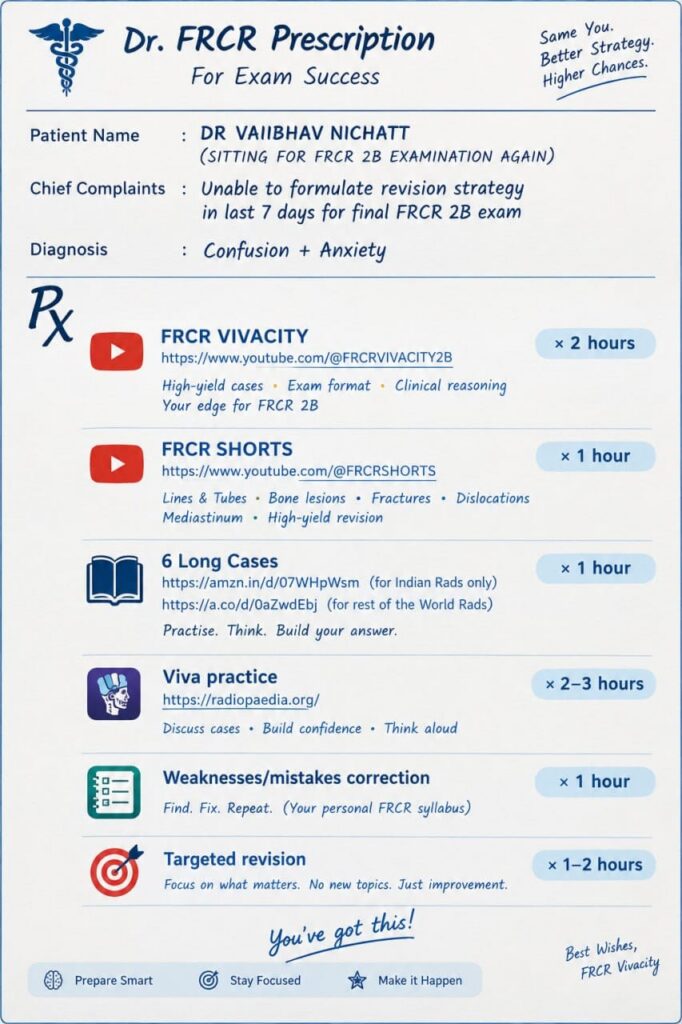
2 hours | FRCR Vivacity videos ( (https://www.youtube.com/@FRCRVIVACITY2B) |
1 hour | FRCR Shorts (https://www.youtube.com/@FRCRSHORTS) |
1 hour | FRCR Shorts (https://www.youtube.com/@FRCRSHORTS) |
1 hour | 6 Long Cases (https://amzn.in/d/07WHpWsm – for Indian Rads only; https://a.co/d/0aZwdEb for rest of the World Rads) |
2–3 hours | Viva practice (https://radiopaedia.org/) |
1-2 hours | Targeted revision |
1 hour | Reviewing mistakes |
Adjust the split to your weak areas. The principles stay the same:
- Cases over passive reading
- Active recall over watching
- Timed practice over untimed practice
- Feedback over repetition without correction
What Should You Avoid With Only 7 Days Left?
I wouldn’t:
- Start a new textbook from page one
- Try to revise all of radiology
- Watch hundreds of random videos
- Make elaborate notes
- Keep switching resources
- Practise without a timer
- Skip management or relevant negatives
- Spend my time revising what I already know
Most of all, I wouldn’t panic about the thousands of cases I haven’t seen. Nobody sees every possible FRCR case. The goal isn’t to know everything. It’s to make what you already know exam-ready.
The Right Mindset for the Final 7 Days
Stop asking, “What else can I study?”
Start asking, “How can I perform better with what I already know?”
Can I describe faster? Can I pick out the key finding? Can I mention the relevant negative? Can I reach the diagnosis, handle follow-up questions and suggest sensible management, all within the time limit?
In the final week, the biggest gains rarely come from learning 500 more facts. They come from learning to turn existing knowledge into marks.
Frequently Asked Questions
- How many hours a day should I study in the last week before FRCR 2B?
Around 10-12 focused hours is realistic if the week is fully free. Protect your sleep, especially the night before the exam. - How many long cases should I practise before FRCR 2B?
About 6 a day works well in the final week. Write out one full answer daily and mentally structure the rest. - What’s the best way to practise for the FRCR 2B viva?
Simulate the real thing. Give yourself 5 minutes per case, answer aloud, get feedback, then move on. Three short sessions a day beat one long one. - Should I start new resources in the last week?
No. Stick with one trusted set of resources and use it actively. Switching now spreads your attention too thin.
Ready for Your Final Week?
7 days. 84 focused hours. Practise cases, speak your answers, write concisely, time yourself, find your weaknesses and fix them.
Then walk into the exam with one objective: see it, describe it, interpret it, diagnose it, manage it, all within the time.
Start now with the FRCR Vivacity channel, revise high-yield topics on FRCR Shorts, and grab your copy of Crack FRCR 2B Long Cases (India | worldwide).